Free may be enough if
You only need to test prompts, compare Runable with the alternatives, or run one small project before making a buying decision.
Runable Pricing Guide
Runable pricing is worth judging by workflow volume, not only by the number on the pricing card. The plan that makes sense is the one that can handle your real weekly projects without pushing you into credit anxiety.
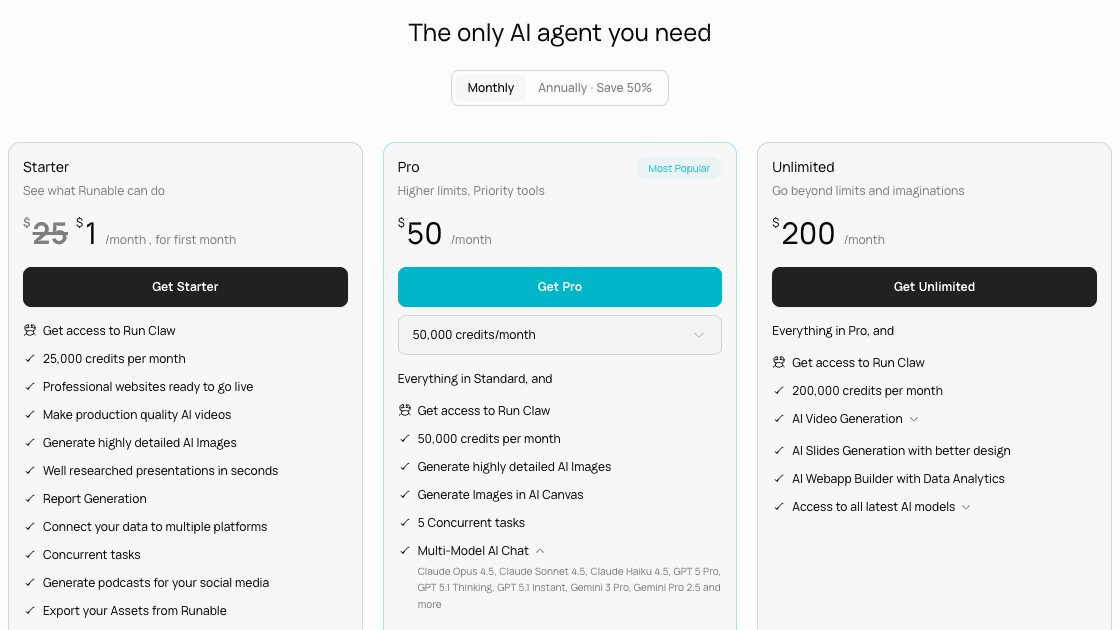
Most users should start with the smallest plan or trial that lets them finish one real project. Upgrade only when Runable is already saving time across repeated work, such as research to brief, brief to landing page, and landing page to follow-up assets.
| Pricing question | My answer |
|---|---|
| Best first step | Use the lowest viable option to run one real workflow before paying more. |
| Most likely upgrade trigger | You repeat multi-step projects every week and credits, speed or exports start limiting delivery. |
| When free may be enough | You are testing prompts, learning the interface, producing occasional drafts or still deciding whether Runable fits your first workflow. |
| When paid makes sense | Runable replaces at least two separate tools or handoffs in your normal workflow. |
| Solo founder plan choice | Start with the lowest plan that supports one weekly workflow, then upgrade only when credits or exports block delivery. |
| Who should wait | Casual AI users, pure chat users and people who only need one narrow specialist tool. |
What Changed My Mind
After testing Runable inside actual weekly work, the pricing question changed for me. At first I wanted to know whether it could replace six AI tools. That was the wrong benchmark. The better question was whether it removed enough handoffs from one repeatable workflow to feel worth paying for again next month. For my own workflow, I would start small, run one serious research-to-deliverable project, then upgrade only if the limits showed up in real work. I would not pay extra just because the product looks broad. The moment I would consider paying more is when Runable becomes part of a weekly routine, not when one demo looks impressive.
Use the official pricing page as the source of truth for current amounts, plan names and credit rules. My recommendation is to read the pricing table through the lens of output volume: what can you finish each week before you hit a limit?
Pricing source: official Runable pricing page. Last checked: June 29, 2026. Because AI pricing changes often, verify the live page before paying.
| Plan type | Best for | What to verify | Upgrade trigger |
|---|---|---|---|
| Free or trial access | Learning the product and testing one small workflow. | Credit allowance, output limits and whether exports are included. | You can finish useful drafts but run out of capacity. |
| Entry paid plan | Solo users with weekly projects and a clear repeatable use case. | Monthly credits, commercial usage, project limits and renewal terms. | You need more volume, faster iteration or reliable delivery. |
| Higher paid plan | Teams, agencies or operators producing several deliverables each week. | Seats, collaboration, workflow limits, support and usage caps. | Multiple people depend on Runable for client or business workflows. |
The free or trial path is for proof, not commitment. It is enough when you are testing whether Runable can understand your context, produce a structured first draft and reduce tool switching. A paid plan becomes easier to justify when the same workflow repeats often enough that limits slow you down.
You only need to test prompts, compare Runable with the alternatives, or run one small project before making a buying decision.
You are using Runable for weekly deliverables and the workflow guide matches how your work actually moves from input to output.
Use this quick path if you are trying to decide whether to pay now or wait.
| Question | If yes | If no |
|---|---|---|
| Do you use AI for real work every week? | Test Runable with one complete workflow. | Stay with a free or chat-first tool for now. |
| Does one project require several tools? | Runable has a clearer value case. | A specialist tool may be cheaper and simpler. |
| Did Runable save time in at least two stages? | Consider the lowest paid plan that fits your volume. | Do not upgrade yet. |
| Are credits or exports blocking repeated work? | That is the cleanest upgrade signal. | Use the current plan until the limit is real. |
I would choose by user type, not by the most attractive feature list.
You are still validating the product, comparing it with ChatGPT or Claude, or learning how Runable handles your source material.
You are a solo founder, marketer or consultant with one or two repeatable weekly workflows. Pair this with the first tutorial before you upgrade again.
You work with a team, produce client deliverables, need more credits, or depend on Runable for several asset types.
You cannot name the workflow Runable will replace or you only use AI a few times per month. Use the alternatives page if a specialist tool may be enough.
These are the practical questions that matter more than the plan names.
| Scenario | Best decision | Next page |
|---|---|---|
| Which plan should a solo founder choose? | Start with the lowest plan that completes one weekly workflow without friction. | Run the first project |
| Free plan still covers testing | Do not upgrade until a real workflow hits a credit, export or speed limit. | Check workflow fit |
| Paying replaces two or more tools | A paid plan becomes reasonable if it reduces repeated handoffs every week. | Read the full verdict |
| One specialist task dominates | Compare alternatives before paying for a broad workflow tool. | Compare alternatives |
Upgrade when the limit is visible in your own work. If you are finishing a research brief, landing page draft, slide outline and follow-up content every week, the paid plan has a clearer job. If you are still exploring, more capacity may only hide an unclear workflow.
The buying test: run one real project end to end using the tutorials. If Runable saves time in at least two stages of that project, then a paid plan deserves serious consideration.
Runable is less convincing when your work is narrow. If you mostly need open-ended conversation, ChatGPT may be simpler. If you mostly need long-form writing and careful analysis, Claude deserves a direct comparison. If you only need slide decks or visual design, Gamma or Canva may be cleaner.
The biggest risk is paying for broad capability before you know which workflows you will repeat.
Compare Runable against the tools it would replace, not against one isolated feature. The alternatives page breaks that down by user type.
The monthly price is only part of the buying decision. Check the operational limits before you make Runable part of client work or a repeatable business process.
Which workflows consume credits fastest, and what happens when you run out?
Can multiple people use the workspace without messy account sharing?
Can you use generated work for client projects, public pages or paid deliverables?
If you plan to turn Runable into a repeatable operating process, check account terms, data handling and the FAQ before building around assumptions.
Know when renewal happens and how cancellation works before a trial turns into a paid subscription.
Runable may reduce handoffs, but you still need to review claims, pricing, data and final copy.
Cheaper is not always better. The real comparison is whether one Runable plan replaces several narrower subscriptions, or whether you still need those tools anyway.
| Tool | Pricing lens | Best for | Main tradeoff |
|---|---|---|---|
| Runable | Workflow breadth and credits. | Projects that move across research, planning and deliverables. | Can feel expensive if you only need one narrow task. |
| ChatGPT | Chat and reasoning subscription value. | Flexible conversation, brainstorming and quick analysis. | Less focused on finished multi-format project workflows. |
| Claude | Writing and long-context value. | Documents, editing, careful analysis and strategy work. | Not a full production workspace for every asset type. |
| Gamma | Presentation-focused value. | Slide decks and polished presentation drafts. | Too narrow if your project also needs research, copy and reports. |
| Canva | Design and template value. | Brand assets, social graphics and manual visual polish. | Design control is stronger than workflow planning. |
Start small. Use the full review to decide whether Runable fits your work, run one tutorial project, then check the current pricing page. If you still have buying doubts, the FAQ covers free plans, alternatives, account safety and publishing concerns. I would pay only if Runable reduces repeated handoffs in a workflow I already do every week.
Check the live Runable pricing page before deciding. Free access, trial terms and credit rules can change, so I would not choose a plan from an old screenshot.
Start with the lowest option that lets you run one real weekly workflow. Solo founders should usually test one research-to-deliverable workflow before moving beyond the entry paid tier.
It is harder to justify if you only need casual chat, one-off brainstorming or a specialist tool such as a slide maker or design editor.
Check credits, seats, exports, commercial usage, cancellation terms, renewal timing and whether important workflows sit behind a higher tier.
Verify the current cancellation flow on Runable before paying. I would check whether cancellation is self-serve, when access ends and whether unused credits carry over.
Check the live pricing and billing terms before purchase. Refund rules, annual discounts and renewal policies can change faster than independent reviews.
Sometimes, but only if it replaces enough repeated handoffs. If you still keep ChatGPT, Claude, Canva and a slide tool, the savings may be smaller than the pricing page suggests.
Pricing Verdict
Runable pricing makes the most sense when the tool replaces repeated production steps. Do not upgrade for vague potential; upgrade when your own workflow proves the value.